"Supply-side economics" is an extremely common term in the media as Google searches demonstrate. But searches of the academic literature yield very few hits and most of these hits are not describing any sort of academic school of thought. Supply-side economics is a political philosophy with economic implications, not a part of economics and that is why it rarely even merits a mention in economics textbooks. THE central idea of the supply-side political philosophy is that lower taxes are good for the economy. It is that simple. Wikipedia also says that supply siders like lower regulation, and this is often part of supply side rhetoric, but that is a secondary issue and Wikipedia gives no examples of any regulations that supply siders oppose. Supply siders generally support regulations that increase the rights of property holders and oppose things like minimum wage laws and environmental laws, but these are not as important to supply siders as low taxes and ideas about regulations are less universally agreed upon in this movement.
The "supply-side economics" movement is closely associated with the Wall Street Journal (WSJ) editorial page which has long promoted the concept. A WSJ journalist, Jude Wanniski, is often credited with coining the term in 1975 around the time when he clearly coined the term, "Laffer Curve", which is perhaps the most important tenant of supply side economics.
Read Wikipedia for more explanation of supply-side economics. It is pretty good, but I disagree with a few points, such as the characterization that "supply side economics is a school of macroeconomic thought". It is as much a school of macroeconomics as Marxism is or as creationism is a school of biology. None of these "schools" have much mainstream influence in academia even though they are common in the media and all have had a lot of political influence at different times and places.
Wednesday, September 28, 2011

Tuesday, September 27, 2011
Deflation
Krugman on deflation:
inflation and deflation are not symmetrical. Four percent inflation does very little harm; four percent deflation is a disaster. Why? Three reasons:
4. The problem in a recession is that people want more money and less goods and services. Deflation makes consumer, want to wait to buy stuff because prices are coming down and hoarding cash becomes even more attractive as it is going up in value.
5. Banks become less interested in lending money when they can earn a real interest rate by simply holding cash rather than lending it out to someone who may not pay it back as the real debt burden of a loan compounds with the deflation rate. The increased real interest rate burden of a loan (nominal interest rate plus the absolute value of the deflation rate) also makes borrowers more hesitant to borrow.
6. (related to #3) Deflation can increase bankruptcy rates which reduces the spending of both the debtor and the creditor until it is sorted out which can take a long time. Many simultaneous or big bankruptcies can paralyze a financial system and bring down an economy. This was the fear during the 2008 financial crisis. Even in the long run, bankruptcy is an expensive process with high transactions costs that reduce the productivity of an economy.
inflation and deflation are not symmetrical. Four percent inflation does very little harm; four percent deflation is a disaster. Why? Three reasons:
1. The zero lower bound: you can always raise interest rates, but you can’t cut them below zero, so deflation means significantly positive real rates even in the depths of a slump, making monetary stabilization much harder if not impossible.And there is more.
2. Nominal wage rigidity: it’s hard to get wage cuts — always has been, and always will be. So deflation messes up labor markets.
3. Debt: deflation is always contractionary, because it redistributes wealth to creditors and away from debtors, who are almost by definition more likely to be spending-constrained. And in the euro context this means that imposing deflation on debtor countries worsens the downward pressure on the European economy.
So European policy that requires deflation on the part of a large part of the zone is a real disaster.
4. The problem in a recession is that people want more money and less goods and services. Deflation makes consumer, want to wait to buy stuff because prices are coming down and hoarding cash becomes even more attractive as it is going up in value.
5. Banks become less interested in lending money when they can earn a real interest rate by simply holding cash rather than lending it out to someone who may not pay it back as the real debt burden of a loan compounds with the deflation rate. The increased real interest rate burden of a loan (nominal interest rate plus the absolute value of the deflation rate) also makes borrowers more hesitant to borrow.
6. (related to #3) Deflation can increase bankruptcy rates which reduces the spending of both the debtor and the creditor until it is sorted out which can take a long time. Many simultaneous or big bankruptcies can paralyze a financial system and bring down an economy. This was the fear during the 2008 financial crisis. Even in the long run, bankruptcy is an expensive process with high transactions costs that reduce the productivity of an economy.
Monday, September 26, 2011
Goldbuggery
Beware of investor 'tips'. There are often hidden financial ties to the investments that are being promoted. If you believe in the efficient market hypothesis, investing tips should be worthless. Here is a "gold bug" email I got. Be very skeptical.
GOLD could be one of the biggest events in history–the one that could blow past what investors saw in oil, and dotcoms.
Powerful forces are at work, threatening financial chaos, yet I am bringing you one idea that could save you...
Gold could be marching to $2,500, $3,000 or even $5,000 an ounce.
Powerful forces are pushing gold to unprecedented highs. With a US currency crisis imminent, you should consider gold now. You can see that GOLD is where the opportunities have been recently...

Saturday, September 24, 2011
Was Housing or Banking Responsible For Recession?
Banker Daniel Davies claims that the bankers did not cause the recession. The housing industry did. Delong disagrees:
Alas! I think that the bankers did do it.Both housing prices and housing starts peaked in 2005. The recession did not officially begin until just before the beginning of 2008. Note that the bubble in housing construction is long since over:
Lets start at the height of the U.S. housing boom in 2005:III, when residential construction reached its peak value as a share of potential GDP. At that moment it dawned on lenders that Option ARMS and subprime buy-to-let teaser mortgages were really not the best businesses to be in, and it dawned on potential borrowers that Option ARMS and subprime buy-to-let teaser mortgages were really not the best financial liabilities to assume--especially because they came bundled with an overpriced house. So after 2005:III the U.S. residential construction sector began to shrink. And it shrank, and shrank, and shrank. By the end of 2007--a little over two years later--it was down by 2.5% of potential GDP as housing prices fell and mortgage financing dried up.
But had the economy slid into recession? No. As residential construction stood down, exports stood up. Foreigners earning money from selling imports to the U.S. no longer invested their earnings in MBSs. Instead, they bought exports from the U.S. Residential construction down by 2.5% of potential GDP, exports up by 1.9% of potential GDP--the market economy was doing fine. It was rebalancing in response to a shock to fundamental expectations just as Jean-Baptiste Say would have said it ought to back in 1803. And Friedrich Hayek's claim--the claim of the entire Marx-Mellon-Hoover-Hayek axis, in fact--that a speculative bubble orgy like 2004-2006 was a sin that had to be paid for in blood and pain and fire and unemployment? Wrong, up until the end of 2007.
But what happened in the two years after the last quarter of 2007? Housing construction continued its decline, even though at the start of 2008 it was plausible and by the end of 2008 it was undeniable that the housing bust had been sufficiently long and deep to erase any Hayekian overbuilding of residences. And throughout 2008 equipment investment and exports fell off the cliff, gradually at first and then at a stunning pace.
Why did they do this? It wasn't because, as Daniel claims, of "the disappearance of a huge amount of household sector wealth. It did disappear. But wealth had disappeared before--remember Black Monday on the stock market in 1987, or the collapse of the dot-com boom?--without it triggering a Lesser Depression. It was because people recognized that banks that were supposed to have originated-and-distributed mortgage-backed securities had held on to them instead, that as a result a large chunk of the $500 billion in subprime losses had eaten up the capital base of highly leveraged financial institutions, and that you were running grave risks if you lent to a bank. The run on the shadow banking system that followed was the source of the crash as financing for exports and for equipment investment vanished, and then the whole thing snowballed.
No banks losing track of the risks they were running and holding on to assets that were supposed to be originate-and-distribute, no financial crisis, no credit crunch, and no Lesser Depression. The housing bubble would have deflated, unemployment would now be near 5%, exports would have boomed, and our biggest worry right now would probably be a "weak dollar".


the housing bust since 2007 has been much larger than the mid-2000s housing boom, and that there is no overhang of overbuilt houses, rather the reverse:

Friday, September 23, 2011
Austerians In Europe
Krugman:
It took bad thinking and bad policy by many players to get us into the state we’re in; rarely in the course of human events have so many worked so hard to do so much damage. But if I had to identify the players who really let us down the most, I think I’d point to European institutions that lent totally spurious intellectual credibility to the Pain Caucus. Specifically:
- The OECD, which a year ago demanded both fiscal austerity and a sharp rise in interest rates, because, well, because. Recently the OECD surveyed Britain, concluded that inflation is likely to decline, unemployment to rise, and that the UK should therefore … continue with fiscal austerity and raise rates. As a correspondent wrote, “What planet are they living on? What planet am I living on?”
- The ECB, which bought totally into the doctrine of expansionary austerity, despite overwhelming evidence that it was false, and proceeded to raise rates in the face of a deeply depressed economy — possibly the straw that breaks the euro’s back.
- The BIS, which called for tighter monetary policy just three months ago, to fight a nonexistent inflationary threat. Did I mention that inflation expectations, as measured by the difference between yields on ordinary and index bonds, have been plunging like a stone?
I haven’t developed a full theory of the sociology going on here. But these organizations should be doing some agonized soul-searching, asking how they got it so wrong while posing as high priests of economic expertise.
Thursday, September 22, 2011
Competing Theories Of The Lesser Depression
Mike Konczal:
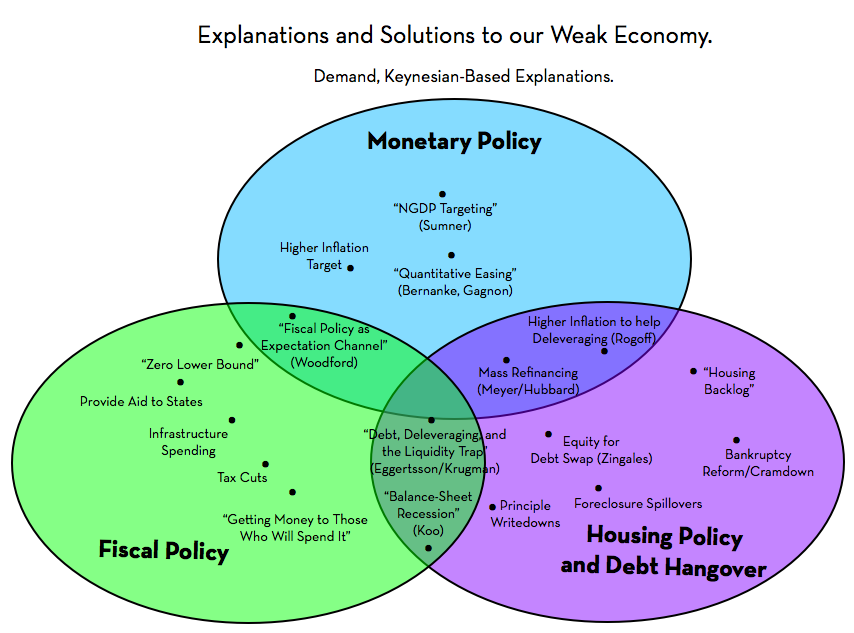
For the next few posts I need to allude to an ongoing battle of ideas about what is troubling our economy and what solutions are available. I figured it might be a good idea to try and create some sort of topological map of the various clustering of ideas and policies that constitute these arguments as well as the overlap among them. This is a preliminary version of this map: I’d really appreciate your input about what is missing and how to make this better.
From those who think that the problem is related to demand and Keynesian ideas, there tends to be three areas of focus: fiscal policy, monetary policy and the debt hangover in the broken housing market. One can think all three are important – I certainly do – but most think one has priority over the others. Many will think one of the three isn’t in play or particularly useful as a focus of policy and energy. Here’s a rough map. Quotations are ideas, non-quotes are policies and parentheses are people associated with each:
This war of ideas is being fought in white papers and articles, and at academic institutions, policy shops and the blogosphere. As a general resources, here are the best one-stop resources online for most of the bulletpoints above:
Fiscal Policy as Expectation Channel: Woodford on Monetary and Fiscal Policy, Paul Krugman.
Quantatitive Easing: The World Needs Further Monetary Ease, Not an Early Exit, Joe Gagnon.
NGDP Targeting: The Case for NGDP Targeting: Lessons from the Great Recession, Scott Sumner.
Mass Refinancing: Economic Stimulus Through Refinancing — Frequently Asked Questions, R. Glenn Hubbard and Chris Mayer.
Inflation to help Deleveraging: U.S. Needs More Inflation to Speed Recovery, Say Mankiw, Rogoff, Bloomberg. Overcoming America’s Debt Overhang: The Case for Inflation, Chris Hayes.
Higher Inflation Target: A 2% Inflation Target Is too Low, Brad Delong.
Bankruptcy Reform/Cramdown: January 22nd, 2008 Testimony, Adam Levitin.
Foreclosure Spillovers: Foreclosures, house prices, and the real economy, Atif Mian, Amir Sufi and Francesco Trebbi.
Balance Sheet Recession: U.S. Economy in Balance Sheet Recession: What the U.S. Can Learn from Japan’s Experience in 1990–2005, Richard Koo.
Housing Backlog: There is a Boom Out There Somewhere, Karl Smith. Yes, Virginia, Our Housing Stock Is Now Way, Way Below Trend, Brad Delong.
Debt-for-Equity Swaps: Why Paulson is Wrong, Luigi Zingales.
Debt, Deleveraging, and the Liquidity Trap: Debt, deleveraging, and the liquidity trap, Paul Krugman. Sam, Janet and Fiscal Policy, Paul Krugman.
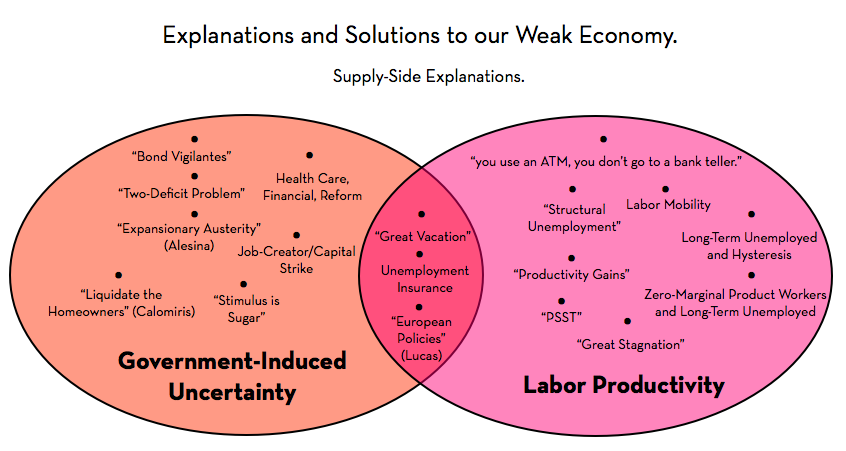
The flip-side to a demand crisis is a supply crisis, and there’s been a large effort to explain our high unemployment and below-trend growth as the result of supply-side factors. Having surveyed the arguments, I’ve split them into two categories. There are those who think that the government has created an increase in uncertainty. This is from a combination of deficits that scare bond vigilantes/job creators, new regulations that have killed all the potential new jobs as well as the government creating disincentives to work. The second area of focuses is on the productivity of the labor force, with special emphasis on skills mismatch, the characteristics of the long-term unemployed and the idea that something has changed fundamentally in our economy that will keep so many unemployed for the foreseeable future.
I’m making the productivity circle conceptually expansive enough to include “recalculation” stories, though I suppose I could add a third circle in the next version. I tend not to find these arguments convincing, but here are the arguments made in full as best as I could find them online:
European Policies: The U.S. Recession of 2007-201?, Robert Lucas. The classical view of the global recession, Gavyn Davies.
Expansionary Austerity: A Guide for Deficit Reduction in the United States Based on Historical Consolidations That Worked, AEI. Large changes in fiscal policy: taxes versus spending, Alesina and Ardagna.
Liquidate the Homeowners: Are Delays to the Foreclosure Process a Good Thing? Charles Calomiris and Eric Higgins.
Stimulus is Sugar: Geithner Finds His Footing: Zachary Goldfarb.
Two-Deficit Problem, Bond Vigilanties: Spend and Save, Noam Scheiber.
Great Vacation: Compassionate, But Inefficient, Casey Mulligan. The Dirty Secret of Unemployment, Reihan Salam.
Long-Term Unemployed: Potential Causes and Implications of the Rise in Long-Term Unemployment, Andreas Hornstein, Thomas A. Lubik, and Jessie Romero. 10 Percent Unemployment Forever?, Tyler Cowen, Jayme Lemke.
Great Stagnation: The Great Stagnation, Tyler Cowen.
Patterns of Sustainable Specialization and Trade (PSST): PSST vs. the Aggregate Production Function, Arnold Kling.
Labor Mobility: Housing Lock is not a Major Part of this Crisis, Plus Scatterplots of Deleveraging!,
Wednesday, September 21, 2011
Expectations and Monetary Policy
Yglesias:
Planet Money did an enlightening explanation of what an “operation twist” effort might look like for Morning Edition today, but it said something that I want to take issue with, namely the claim that “[t]he Fed has at its disposal one key tool: interest rates.” This is certainly what certain popular models say, but it doesn’t really make sense theoretically.
My thinking on this has been influenced a lot by the group of people who I guess we’re now calling “Market Monetarists” (PDF) but is arguably closer to the Old Keynesian view outlined in Chapter 12 of the “General Theory”. Specifically, this beauty contest issue:
Or, to change the metaphor slightly, professional investment may be likened to those newspaper competitions in which the competitors have to pick out the six prettiest faces from a hundred photographs, the prize being awarded to the competitor whose choice most nearly corresponds to the average preferences of the competitors as a whole; so that each competitor has to pick, not those faces which he himself finds prettiest, but those which he thinks likeliest to catch the fancy of the other competitors, all of whom are looking at the problem from the same point of view. It is not a case of choosing those which, to the best of one’s judgment, are really the prettiest, nor even those which average opinion genuinely thinks the prettiest. We have reached the third degree where we devote our intelligences to anticipating what average opinion expects the average opinion to be. And there are some, I believe, who practise the fourth, fifth and higher degrees.The thing is, this works for the economy as a whole. If households anticipate rising incomes, they’re more likely to buy things. And if firms anticipate rising sales, they’re more likely to expand activities. And if firms expand activities, incomes are more likely to rise. So optimism about the state of things can be self-justifying. This isn’t a magic trick. If firms face binding constraints on their ability to produce, no amount of optimism will change that fact and all economies do face objective scarcities of natural resources and appropriately skilled labor. But within the range of objectively possible production, there’s a range of plausible outputs and expectations are crucial to determining how closely actual output matches potential output. Yet, as in Keynes’ beauty contest there’s this terrible indeterminacy. What do I expect the average expector to expect me to expect? What’s needed, in essence, is for someone to show up and tell us what to expect.
In this view, the key thing about the modern central banker is simply that we’ve all agreed that he’s the guy in charge. “Don’t worry folks, if your business is profitable you should be expanding production because all the other profitable businesses will also be expanding so there will be customers for your profitable products.” It’s a social convention, and the convention is self-validating. As long as we all agree to agree that we’ll agree that what the central bank says is important, it is important. This is why central banking is cloaked in mystery, why it’s “apolitical,” while meeting transcripts need to be delayed for years, etc. Central bankers have generally preferred to use short-term interest rates as their tool of choice, but this is fundamentally just one of the Wizard of Oz’s tricks. In an ideal world, the head of the bank would go on television waving a stopwatch and hypnotize the audience. To boost output say: “at the margin, you will on average decrease your interest in owning dollars and dollar-denominated safe liquid financial instruments.” To curb inflation say: “at the margin, you will on average increase your interest in owning dollars and dollar-denominated safe liquid financial instruments.” But of course everyone knows that stopwatches can’t really hypnotize people, so they use interest rates instead. With short-term nominal interest at zero, bankers need to pick a different instruments but there are plenty of things they could choose. What matters is that they choose something and back it up with some bold talk about how people are going to want to own fewer dollars and dollar-denominated safe liquid financial instruments.
This is all sounds kind of nuts, because it is. That’s why New Keynesians want to believe it’s all about interest rates and it’s why Market Monetarists like to daydream about an NGDP futures market. I think the world’s just a bit weird and nutty.
Subscribe to:
Posts (Atom)